Mar 21, 2010

Semakau OJT 2

Trip 3 Semakau Trip 2 OJT
What I really love about all of this is that everytime it's different you never know what you are going to see.. Sort of like calls but in a much nicer way.. And presenting the "cases" is alot more fun :)Firstly, this trip Lk and a few others had been on Semakau for a few days before hand collecting specimens for RMBR. Bird specimens.. Well they had some mist nets out and "collected' this guy by mistake.

Dog faced fruit bat - Only had a chance to snap a quick picture before he was released. Obviously the poor guy was stressed and doing a " dracula" on me. Think the reason the people are so scared of them is because of all the bad press they get. Read an article once that in the whole of North America you get a few 1000 deaths from motor accidents and only 3-4 cases of rabies from bats. And all those cases were from people who handled a sick bat.. So if we really want to decrease mortality lets just ban cars.. Solve alot of problems won't it carbon emissions and all.. So those who propose to have bat eradication programmes should just sell their cars and picket car show rooms if they really want to make a difference.

Just a slight digression.. I just feel really strongly about people squeaking and hiding over some of the coolest creatures I have ever met. All those Dracula shots we see are generally of wild stressed bats just pulled from the net (the easiest way to lay hands on one of these nocturnal fliers). However take a look at the results from people who made friends with them.. This are some shots I took in Cairns Australia. Lady (That'll i'll forever remember as the bat lady) there runs a bat rescue and rehab shelter. Her friend here Tillie is an Australian flying fox. Prev brought in injured and now totally well Tillie is free to come and go and though she forages on her own she still snuggles up for a few "biccies" and no she is not tame. She wasn't some pet that I could touch (though I was dying to) Only Bat Lady was allowed to touch her.. Not threatening at all right?
Another resident an Albino Mexican Free tail. I've actually got some friends to admit that these 2 are actually cute. Speaks volumes on how different a stressed shot is from a relaxed one. Believe all these misconceptions are just due to bad press. Tillie eats fruits (and occasionally biscuits) Mexico here is an insect eater. No they do not bite you and no they do not fly into your hair intentionally (why would they want to??) For those who are so scared of Rabies JUST LEAVE THEM ALONE.
A last shot of the bats in Bat Reach the recuperatng bats are in the cage while a few hanger-ons stick around for the company and the occasional biccie. Would love to have a proper resident colony in my garden..
Anyway back to the main walk

A Pair of mating Sand Sifting Sea Stars

For some reason today there were mating pairs everywhere. Singles were the rarity. Without furthur ado the students I had with me christianed this strip the "Red light district". I fed them the dry stuff about how the male (the starfish on top) positions himself such that his arms interspace with that of his girl and that mating occurs with a simultaneous release of sperm and eggs.. And they had their own comments " Hey if you put anotherone on top will they have a threesome?" Errr....


A spider conch - not very spectacular on the deck given all the camouflage


But oh so pretty the min you flip it over! Noticed the long curved "claw" across the opening of the shell? That's the Operculum or foot that the spider conch can use to hop or right itself (especially when there is a guided tour:P)


Another Shot.. Gorgeous

The resident Carpet Anemone with it's pair of anemone shrimp. So much more attractive compared to my Cherry shrimp! (Sorry guys). I've been told that the relatioship between shrimp and anemone is really symbiotic. By coating themselves with mucus produced by the anemone the shrimp can avoid it's stings and hide from predators within the anemone. But in return they do not really have a role in cleaning the anemone and in fact may eat it's tentacles if there is a shortage of food..


A living Cowrie -The curse of beauty
Shell used in ancient China and India as a form of currency (Did that make beach combers the richest folk around..?) Look Closely you can probably see the 2 eye stalks sticking out of the upper edge of the shell .
Devoted mothers, they remain with their eggs till they hatch. Sadly more than half the cowrie species in Singapore have been lost as our natural beaches are reclaimed for development - probably the one thing a mother cowrie can’t protect her young from.Young cowries have a shell is a narrow spiral it encloses this spiral shell with a larger outer shell which has the typical cowrie shape and slit-like opening with teeth as the it grows. The inner spiral layers may be reabsorbed to make room for the larger animal and the material reused to build a larger outer shell.


Zooanthids (Colonial anemones)

Like tiny anemonies but not solitary but rather colonial like corals. They don’t produce a hard skeleton like the hard coral colonies. Tissues are leathery and composed partly of chitin (think insect exoskeletons). They feed on plankton/ other finer particles. Many harbour zooxanthellae
Some zoanthids contain powerful toxins to protect themselves against predators. The most toxic marine poison, palytoxin, was discovered in a zoanthid. Minute quantities of palytoxin can paralyse and even kill.Palytoxin, the poison extracted from a zoanthid, has been used to better understand how our body works and may provide better treatment of hypertension, heart disease and other disorders.


Star Anemone - A new first for me!

Has another mode of defence besides it's stingers. When threatened this guy can retreat rapidly back into it's tube home in the ground. Senior guide demoed this for me.. Wow


Upside-down jellyfish - finally got a good photo


Not a fish and are more closely related to sea anemones and corals (Cnidarians)
Jellyfish can sting and some, very painfully. Stingers are still active even after the jellyfish is dead or dying. Upside-down jellyfish can in fact release their stingers into the surrounding waters
They are found throughout the intertidal from the seagrass meadows to the reef flats. Their bodies harbor microscopic, single-celled algae (zooxanthallae). The algae undergos photosynthesis and the food produced is shared with the jellyfish, which in return provides the algae with shelter and minerals. It is the algae which gives the jellyfish its colours. Because it relies on photosynthesis, the jellyfish tends to be found in shallow waters with their bell down and legs up. Interestingly these industrious garderners will even right themselves if over turned.

The release Upside down:)


Saw a few other jellyfish today - This translucent one not so sure about the name.. Apparently can sting quite badly. Long pants definitely a must for inter-tidal walk


Ribbon jellyfish


Sea Urchin - Another 1st for me!

(Urchin is an old name for hedgehog - exactlly what this guy resembles)

Coolest thing was when you looked at it you're actually looking at it's anus.. Surrounding it are 5 white spots - the "eyes" Which can actually sense movement and adjust it's spines appropriately.. It's mouth is on it's underside facing the ground. It's called Aristotle's Lantern after the afore mentioned Greek Philosopher who first described it in his work "History of animals"The mouth itself is a hard beak that can be replaced as it is worn down. Most sea urchins graze on seaweed, detritus from hard surfaces or on immobile creatures such as sponges or encrusting animals.
The one in the picture (Long spined sea urchin) is the most commonly encountered sea urchins in deeper waters. It is believed that these gather together in groups where there are insufficient hiding places from daytime predators.
The roe of this sea urchin (unfortunatly)is eaten resulting in heavy harversting.


Heart cockle (No need to tell you how this guy gets his name)

Unique shape has triggered the imagination of many - the phrase “cockles of one’s heart” – to refer to one’s innermost feelings, the cockle shells in “Mary, Mary quite contrary” had in her rather unusual garden...
Unfortunately again quite popular as a valentine’s gift but the dead dry shell seldom retains it’s unique shape. Much better to leave them in peace and admire them from afar.
And for the some the need is much more pressing then ours some migratory waders consume to up to a ton of cockle flesh in a year!

Feb 22, 2010

I have done what most men do,
And put it out of my mind;
But I can't forget if i wanted to,
Four feet trotting along behind

Day after day, the whole day through
Wherever my road inclined
Four Feet said, "I'm coming with you."
And trotted along behind.

Four-Feet by Rudyard Kipling

Feb 21, 2010

Post Post call


Would have done more work but totally KO-ed yest:P Don't mind the calls but post call is really a pain..

Feb 18, 2010

Semakau 1st walk

Now we go into the main attraction (For me) on Semakau: The intertidal walk. When they created the rock bunds connecting P Semakau to Sakeng part of the original reefs on Semakau were left untouched. Part of Singapore's Reefs that are collectively less than 0.0154% the size of The Great Barrier Reef but with more that 50% of the species there!

First you have to pay to go in.. In blood :P Short walk through a rainforest path to the shore. The mozzies there only get fed when crazy people go for an intertidal walk so beware..

Once out of the forest you are facing a wide expence of shore that seems to stretch out for miles until it fades into the sea. The sheer contrast between this and the damp closeness of the rainforest.. Oh and no mosquitoes :)
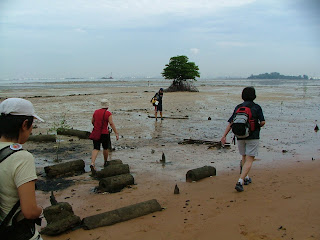


Every inch of shore is teaming with life so place your steps with care. Like these little Creeper snails scribbling their signature in the sand as they graze on the sand. Seafood lovers are familiar with their larger cousins (Chut chut) that they claim are best served fried with chili and garlic.


In the distance a looming reminder one of the main threats facing Semakau: Industrialisation. Chimneys of oil refineries on an adjacent island. Hopefully Semakau will never end up looking like that. As it is the silt thrown up by surrounding developments is clouding up the water..


Another Shore view..


Our Seagrass Meadow and it's path of death.

Seagrass? No not algae. These are marine flowering plants with true roots and stems that are actually related closest to lilies or the common ginger plant. They are callled Eco-system engineers as their thick growth dampens water currents creating sheltered nurseries for small fish and crustaceans. Uses? Support for commercial harvesting, nutrient recyclers - 1 hectare of seagrass can treat effluent of 200 people a year. For these reasons it’s economic value is estimated at US 20 500 an acre. In the wild they also serve as the grazing grounds of many animals eg the dugong.

Very sensitive to changes in water quality. Their leaves are capable of regeneration after being nibbled, but when their root rhizomes are injured their regenerative ability is irreversibly impaired. To avoid excess damage to the patch here we have actually sacrificed some by constant using a fixed path through the lagoon as you can see from the dead strip . This spares the rest of the lagoon some trampling/stirring up of mud at least.


Another shell. Called “Kilah” in malay this is the Noble volute a ferocious hunter, it seeks out buried bivalves with its siphon and encloses the prey in its huge foot then waits. When the exhausted bivalve opens up to breathe (which can take several days), the volute sticks its proboscis in and rasps the flesh of its prey with its tongue. And yes the noble volute is edible and is collected both by shell collectors & for the pot. But not at Semakau. Here the hermit crabs who use the discarded shell for housing get first pick. And anyway the original occupant was still at home you can see a bit of spotted foot peeping at you under the lip of the shell.


Semakau's mine field (But here you do more damage to the mines instead of the other way around) These are the imprints of star fish called the sand sifting sea star (Archaster typicus) They bury themselves during the day and emerge during cloudy days/ at night. Though their name suggests otherwise these are not fish but rather echinoderms which are symmetrical along 5 axis with spiny skin and tube feet. Efficeient bottom feeders, their mouth is located on the center of their “star” on it’s bottom side. They feed by protruding their stomachs from their mouths and mopping up detritus from the sea bed.

Buried sea stars - "bodyprint" caused by them flipping sand up to cover themselves


Another sea star with a moon snail.


This beautiful snail is nocturnal and moves around mainly at night. Contrary to it’s beautiful appearance this snail in reality another formidable hunter. When on the move it inflates it’s body with sea water part of it forms the mantle which covers and protects it’s shell and part of it forms it’s foot with which it ploughs through the sand. When it locates a bivalve it encircles and suffocated it. Or it may choose to secrete a strong acid that soften the shell before using a radula (essentially a tongue with teeth to bore a hole through the shell. You might see other small shells with perfect circles burned into them. Those are all that’s left of a moon snail’s successful hunt.


Gigantic carpet anemone


Hard corals law down a calcium carbonate foundation that acts like a skeleton. This is covered by a thin layer of living tissue made up of individual coral animal called polyps. Each polyp within the colony has a mouth which is surrounded by tentacles that trap food. The skeleton of the coral is called corallite this is a pic of a dead skeleton next to it's living counterpart.


From Latin nudus meaning naked and greek branchia meaning gills this colorful fellow gets his name from these bunches on his back end. They are called branchial plumes from which he breaths. Sort of like carrying it’s lungs/gills on his back. His cephalic (head) tentacles are sensitive to touch and smell and it his club shaped rhinophores that pick up smell. But unlike us it only has simple eyes with only 5 photoreceptors ( we have a few hundred) and can only "see" darkness or light. They are also hermaphrodites (partners fertilise each other they don't self fertilize). Descended from snails they have traded curbsome shells for more efficient defense mechanisms. Some adopt colors similar to that of the sandy floor or even of the corals they live on. Others ingest hydroids or stinging cells from the jellyfish or sponges they eat and express them on theirs skin. The latter few often have an extremely colourful appearance to warn away potential predators. Can they be eaten? Well everything can be eaten though some things only once.. Jokes aside some people do eat them after removing the poisonous organs. Islanders off Russia and Alaska enjoy a variety of boiled/roasted sea slugs.


Not sure who this is specifically..
Overturned...


Not sure but I think those 2 stalks are it's "eyes"


Black marginated Glossidoris... Beautifull


Phyllid nudibranch (being shy and all curled up)


Snapping shrimp
While walking on the sand kept hereing this clickng sound turns oout it was this guy (someone managed to catch one -released later of course) How it clicks? I really don't know must check that out..


Sunflower coral


Everyone brings up Pirates of the caribbean when they see this.. Name? Dead Man's fingers sure look like flaccid water bloated fingers don't you think? This is actually soft coral (Hard coral without it's hard calcium skeleton. Out of water the tiny polyps retract into a soft tissue matrix to avoid drying out when in water they emerge.. Looks like a garden blossoming actually.


Rubbery out of water soft coral

When back in water

Coral gardens


Little Nemo's of Semakau. Found them stranded in a shallow pool. Clown fish - the inseperatable buddies of sea anemonies. A mucus coating protects them from an anemone's sting. While in the anemone they are protected from larger predators. In return they drag their prey back to the anemone for a shared meal. The nemo waits till the anemone has swallowed the food then sticks it's head through the "mouth" of the anemone (center of their tentacles) and takes it's food nicely pre-digested...

Looks like someone has caught the angler fish also called the frog fish because of it’s wide mouth and bulging eyes these fishes are famous for, no pun intended, fishing. Can you see the lure dangling from it’s forehead? The anglerfish dangles that in the water with it’s squat body well camouflaged y the surrounding sand. Small fish are attracted to the waving object and when they come too close… Apart from hunting their camouflage is also important for protection. When flushed from their hiding places in aquariums and clearly visible these fish have been noted to be set upon by wrasse, angel fish and even clown fish and killed.


Pipe fish - relative of the seahorse. Think this one is a daddy.. See the central bulge? The males carry their young llike their cousins.

Feb 17, 2010

Semakau

Now the real reason for this blog. Ever heard of Pulau Semakau. Ok maybe you haven't and I won't blame you. It's essentially a rubbish dump - but one like no other. Commissioned on April fools day 1999, Semakau Landfill was seen as an answer to our growing waste problems and congested landfills. Created by building a 7km rock bund to enclose the sea between Pulau Semakau and Pulau Sakeng, this was lined with an impermeable membrane and marine clay to prevent the leakage of wastes. This was divided into individual ponds that would be sealed and drained when ready to receive the rubbish. In the meantime sea water was left to flow in the unused ponds making them a haven of marine life and attracting fisherfolk of both the rod and feathered variety. Much of the original mangroves on Pulau Semakau were conserved and currently reforestation projects are being carried out to replenish the mangroves. Seen as an eco friendly move this also serves as a leakage indicator for any mangrove in the vicinity of a leak would die. Here are some shots on the island:

Clean energy on Semakau: Wind and solar energy


Lagoon surrounded by the rock bund

Monitoring wells to check for leakage water samples are collected regularly


Picnic sites! Super strong ocean breeze. Semakau is also offering recreational activities like cycling, kite flying, star gazing and fishing. Had a fantastic BBQ here.

You won't believe that that this is a landfill right? As the lots are filled they are covered with soil and seeded. Already many small trees growing making them look like a normal patch of wild grassland. And because it is mainly insinerated trash - there is no smell. I didn't have any good pics of the "true" Semakau. Right at the jetty is a huge building where refuse, comprising incinerated waste from our three incineration plants and construction debris, first arrives from the mainland. It houses 3 ton trucks, cranes that lift one ton of ash at a go, barges that tip the scales at 3500 tons. (these barges are parked at night to avoid busy sea traffic) With incineration reducing the amount of rubbish by? 90%, it is expected (or hoped) that semakau will continue to fulfill our land fill needs till 2045. And after that who knows? An island get-away?